
Vibe Coding the Shack: The Hidden Risks in Replacing HamClock
/LINK 26-002/The Modern Ham/OpenHamClock
Tux
3/17/20263 min read
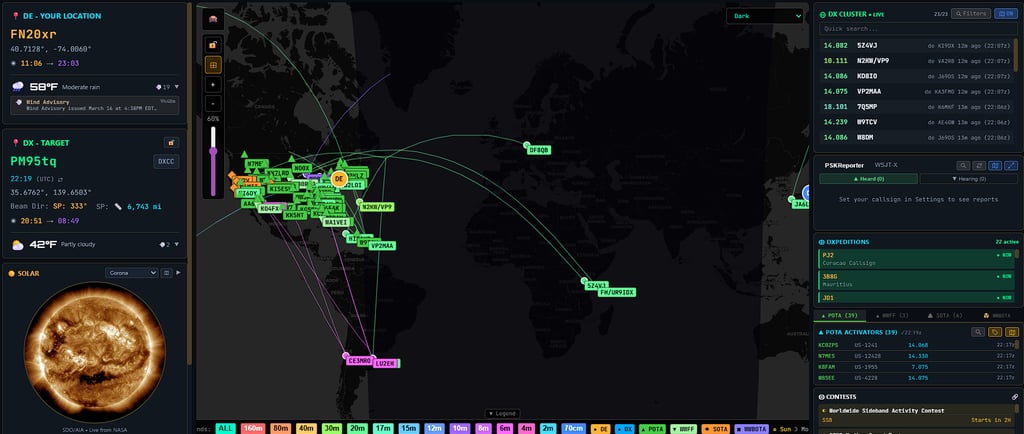
REF/A/"OpenHamClock"/"https://openhamclock.com/"
REF/B/"Github - accius/openhamclock - pull request #694"/"https://github.com/accius/openhamclock/pull/694"
When Open Source Moves Faster Than Engineering
After Elwood Downey (WB0OEW) passed away, the amateur radio community moved quickly to keep HamClock alive. Several replacement efforts appeared almost immediately. One of the more visible was OpenHamClock, an attempt to extend and modernize the project.
Speed is understandable when a widely used tool suddenly loses its maintainer.
But speed introduces risk.
A recent pull request discussion in the OpenHamClock repository exposed serious concerns about AI-generated code, lack of security review, and fundamental architectural weaknesses in the project.
GitHub discussion:
https://github.com/accius/openhamclock/pull/694
AI-Generated Code Without Engineering Review
The reviewer reported three vulnerabilities out of eighteen identified issues.
1. Rotator Endpoint Authentication Failure
The application exposed endpoints controlling a rotator feature.
Problems discovered:
Authentication middleware was missing
The feature was enabled by default despite UI indications suggesting otherwise
Default deployments sent commands every 5 seconds to a hard-coded IP (192.168.1.43)
Example observation method:
tcpdump -i any dst port 12000 -A
This showed rotator commands being transmitted continuously on a fresh install.
Even after fixes were merged, the system still allowed authentication bypass if the user had not configured API_WRITE_KEY, creating a fail-open design.
2. Credential Proxy Issues
The second vulnerability involved a credential proxy mechanism.
Key observations:
Authentication was missing for certain operations
Outbound connections continued even after failures
Observed using:
tcpdump -i any dst port 443
Repeated connections to external QRZ endpoints were observed when triggering the proof-of-concept exploit.
3. SSRF (Server-Side Request Forgery)
The most severe issue involved SSRF vulnerabilities.
Although the maintainers initially marked the issue as fixed, testing showed it remained exploitable.
Example verification method:
tcpdump -i any dst port 5555 -A
Results showed the server still making outbound connections to arbitrary external hosts.
Additional bypass methods were identified:
DNS rebinding (TOCTOU)
IPv6 bypass
Hostname resolution occurring after validation checks
This allowed attackers to force the application to connect to internal or external systems.
Fake Security Controls
One of the more troubling findings was the presence of fake security mitigations.
Examples reported included:
Log messages indicating actions were blocked
Code paths that did not actually enforce those restrictions
This is a known side effect of poorly supervised AI-generated code: the model generates the appearance of security without implementing it.
Technical Debt From “Vibe Coding”
The project currently contains:
70,000+ lines of code
A 12,000-line backend JavaScript file
From a software engineering standpoint, this is difficult to review and maintain.
There is a well-known principle in engineering:
Every line of code is a liability.
Large AI-generated codebases accumulate technical debt extremely quickly, especially when:
architecture is not planned
security review is skipped
code generation outpaces human review
The reviewer noted that the project appeared to be generating 2–3k lines of code per day, which is not realistically reviewable.
Real-World Impact
The application interacts with multiple external services and APIs.
Issues noted include:
Public endpoints receiving large volumes of garbage API requests
Potential Terms of Service violations with third-party services
Systems that could be used to attack other networks
Because of this, the reviewer advised:
Do not run this code in environments where you care about your data or where the server could be used to attack others.
The Core Issue
The discussion ultimately highlighted a broader problem.
Modern development tools make it possible to generate tens of thousands of lines of code quickly.
But writing code is the easy part.
Secure software requires:
architecture planning
human code review
threat modeling
validation and testing
Without those steps, vulnerabilities become inevitable.
Lesson for the Community
Open source software only works when someone actually understands the code being shipped.
AI tools are useful. Many developers use them.
But they are not a replacement for:
engineering discipline
code review
security testing
The rush to replace a beloved project like HamClock is understandable.
But replacing trusted software with unreviewed AI-generated systems introduces risks that many users may not realize.
--This Article was Made with AI--
#modernham #HamRadio #OpenSource #CyberSecurity #SoftwareEngineering #AIcoding #TechDebt #HamClock #OpenHamClock