
/Project 26-01/MSG 01/A Manpack for Digital HF Under Constraint//
Introduces a digital HF manpack built around the Xiegu G90, DigiPi, and Digirig, and the intent behind documenting its design, behavior, and evolution.
Tux
1/8/20262 min read

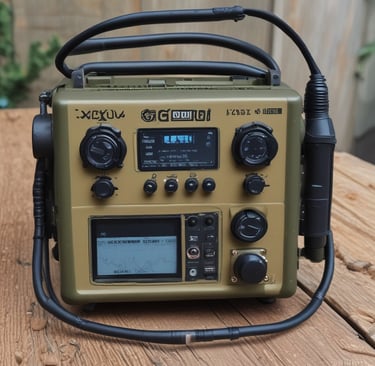
A Manpack for Digital HF Under Constraint
This project started with a simple question: What does a modern, budget-friendly, portable digital HF station look like when it’s built for understanding instead of convenience?
The result is a compact digital HF manpack built around three core components: a Xiegu G90, a Raspberry Pi Zero 2, and a Digirig interface. Each piece is common. The value comes from how they are integrated, constrained, and operated as a single system.
The purpose of this project is not to produce a definitive solution. It is to document a disciplined process of design, integration, and evaluation under practical limits—and to do so openly. This is not about chasing performance numbers. It’s about observing how systems behave when they are self-contained, power-limited, and operated without external infrastructure.
Problem Set
Modern communications systems are increasingly capable, yet increasingly abstracted from the people expected to operate them. Convenience, automation, and external support often replace understanding, until those layers are unavailable.
This project exists to examine that gap.
The core problem set is defined by four competing pressures:
Size — the system must fit within a backpack and remain usable while mobile
Budget — the system must be achievable without premium or specialized equipment
Inventory — priority is given to equipment already on hand
Capability — despite constraints, the system must still deliver meaningful digital HF functionality
The question is not what performs best in ideal conditions, but what remains functional when tradeoffs are unavoidable.
Operational Constraints and Use Case
This manpack is designed for on-the-move operation, not fixed or semi-permanent deployment.
Operating assumptions include:
Use of a non-resonant antenna
Limited time and space for antenna deployment
Minimal tolerance for excess wiring or fragile interconnects
Operation from within the backpack, not beside it
Under these conditions, internal capabilities matter. An internal antenna tuner is not a convenience feature—it is an enabling one. Cable discipline is not aesthetic—it is operational reliability.
The system is expected to function as a single, cohesive unit. External dependencies, sprawling cabling, and multi-piece workflows are treated as failure points rather than features.
System Overview
The system is built around three core components:
A Xiegu G90 HF transceiver
A Raspberry Pi Zero 2 running DigiPi
A Digirig digital interface
None of these components are novel. Their value lies in how they are integrated, constrained, and operated together. This project intentionally favors sufficiency over optimization in order to expose real tradeoffs and behaviors.
Design Philosophy
This project prioritizes:
Understanding over abstraction
Cohesion over convenience
Repeatability over polish
The manpack is treated as a testbed. If a component fails, the failure should be visible and explainable. If a configuration works, it should do so repeatedly under similar conditions.
Comfort, aesthetics, and peak efficiency are secondary to clarity and resilience.
Why This Matters
Communications education often stops at equipment selection or mode familiarity. This project focuses on the seams—where radios meet software, where assumptions meet reality, and where systems either hold together or don’t.
Nothing documented here is final.
If a better approach exists, it should be challenged.
If an assumption proves incorrect, it should be recorded.
If someone else is learning alongside this work, they are part of the record.
This is not a finished system.
It is a working one.
#CommoGods #TacticalCommunications #DigitalHF #OffGridComms #EmergencyComms #HamRadio #XieguG90 #DigiPi #Digirig
Brand
Explore our sleek website template for seamless navigation.
Contact
Newsletter
info@email.com
123-123-1234
© 2024. All rights reserved.